The Blue Mosque, locally known as Sultanahmet Camii, was built between 1609 and 1617 during the reign of Sultan Ahmed I. Standing directly across from Hagia Sophia in the heart of Istanbul’s Historic Peninsula, it remains one of the city’s most visited active mosques and one of the defining landmarks of the skyline.
Today, visitors enter a functioning mosque that is open to both worshippers and tourists. It is known for its six minarets, cascading domes, spacious courtyard, and more than 20,000 hand-painted Iznik tiles that decorate the upper interior walls.
As of April 2026, entry to the Blue Mosque is free for all visitors, with no ticket required. The mosque is generally open daily from 08:30 to 18:30, though it closes briefly during the five daily prayer sessions and remains closed to visitors on Friday mornings until approximately 14:30. Exact daily visiting windows are explained in the Opening Hours section below.
Although entry is free, many travelers choose to join a guided Blue Mosque tour to better understand the mosque’s architectural details, Iznik tile traditions, and the historical meaning behind features that can easily be overlooked during an independent visit.
For a fuller half-day experience in Sultanahmet, you can join a combined Blue Mosque and Hagia Sophia small-group tour, one of Istanbul’s most practical guided itineraries covering both landmarks through GetYourGuide.
I have been guiding travelers in Istanbul for over 20 years, with a particular focus on Ottoman imperial monuments and the city’s mosque heritage. In the rest of this guide, you’ll find clear visiting tips, prayer-time details, dress code notes, and answers to the questions visitors ask most often before entering.
History of the Blue Mosque
The history of the Blue Mosque dates back to the early 17th century. Commissioned by Sultan Ahmed I, the mosque was built in the Sultanahmet district—the historical core of Old Istanbul. Despite its prominence, it is often misunderstood as the largest mosque in the city, which it is not.
During the height of the Ottoman Empire, it became a tradition for sultans to build monumental mosques on the city’s hills. By the 15th and 16th centuries, each of the Seven Hills of Old Istanbul already featured an imperial mosque built by earlier rulers.
However, the first hill—home to Hagia Sophia—remained untouched for centuries. The dense urban fabric of Sultanahmet and the presence of numerous historic structures discouraged previous sultans from building a new mosque in this area.
When Ahmed I ascended the throne in the early 1600s, he sought to leave behind an iconic monument bearing his name. With all major hills already occupied by the mosques of his predecessors, he made a bold decision: to build a new imperial mosque directly opposite Hagia Sophia.
To make this possible, expropriation procedures began in the area next to the Hippodrome. Many houses and shops were purchased by the state and demolished, opening up the necessary space for the mosque’s construction.
The chosen site was historically significant. It once formed part of the Great Palace of Constantinople, the vast imperial complex where Roman and Byzantine emperors had resided. Spreading across large courtyards and extending toward the sea, the palace had already fallen into decline by the late Byzantine period. The final Byzantine emperors had abandoned it in favor of the Palace of Blachernae along the Golden Horn.
Following the Ottoman conquest of Constantinople, this area gradually filled with secondary structures, while the Ottomans established their own residence at Topkapi Palace. In 1609, Sultan Ahmed I cleared much of the remaining fabric and initiated the construction of the Blue Mosque.
Designed by Sedefkâr Mehmed Agha, a pupil of the great architect Sinan, the mosque was completed in just seven years. Tragically, Sultan Ahmed I died at a young age and was able to enjoy his mosque for only a brief period. Nevertheless, the monument he commissioned remains one of Istanbul’s most visited and symbolically powerful landmarks today.
Architecture of the Blue Mosque
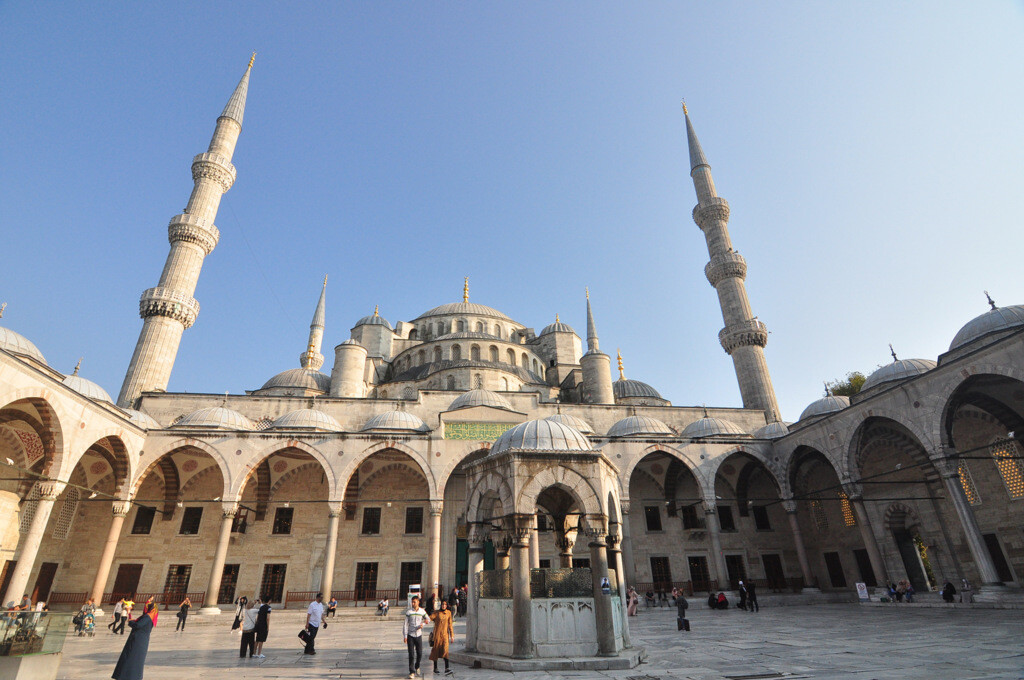
The architectural design of the Blue Mosque reflects the classical Ottoman tradition shaped by Mimar Sinan, even though Sinan himself did not design the building. Its overall plan was inspired by the Sehzade Mosque, a masterpiece Sinan built in the 1540s at the heart of the Historical Peninsula.
One of the most striking features of the Blue Mosque is its six minarets. Until then, imperial mosques traditionally had four minarets, making this design a bold and unprecedented statement. The cascading system of semi-domes surrounding the central dome further enhances the mosque’s monumental yet harmonious silhouette.
Adjacent to the prayer hall is a vast courtyard whose dimensions closely mirror the interior space. This thoughtful design effectively doubles the mosque’s capacity, especially during the summer months when worshippers and visitors spill into the open-air courtyard.
The name “Blue Mosque,” however, comes not from its exterior but from its interior decoration. More than 20,000 Iznik tiles, along with elegant calligraphy and stained-glass windows, adorn the walls beneath the 43-meter-high central dome. The dome itself is supported by four massive pillars—often referred to as elephant feet—which anchor the structure and give the interior its distinctive sense of scale and balance.
Together, these architectural and decorative elements make the Blue Mosque one of the finest and most visually memorable examples of classical Ottoman architecture.
Interior of the Blue Mosque
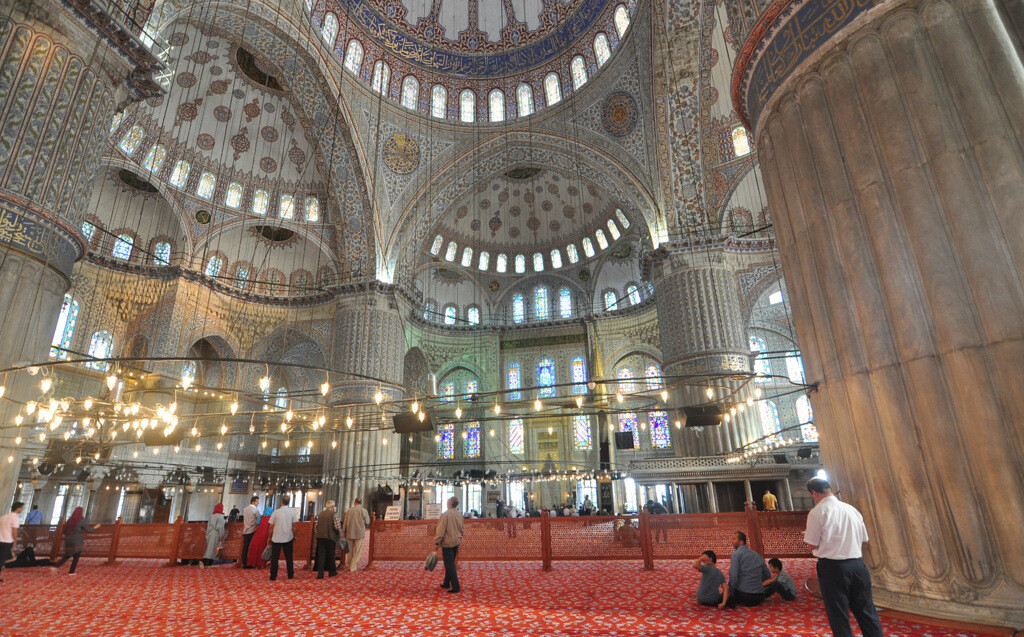
The interior of the Blue Mosque is defined by its extensive use of Iznik tiles, widely regarded as the pinnacle of Ottoman ceramic art. Produced mainly in the 16th century, these tiles feature rich shades of blue, turquoise, and a distinctive pale red that was technically difficult to achieve. During this period, as Istanbul was being adorned with monumental mosques, palaces, and tombs, tile workshops pushed their artistic and technical limits to meet imperial demand.
While the lower walls are covered with tiles, the upper sections and ceilings are decorated with delicate hand-painted floral and geometric motifs, known as pencil work. These decorations rise from the tops of the massive columns and flow seamlessly toward the central dome. Beyond their decorative beauty, these paintings serve a practical purpose: visually lightening the imposing presence of the giant supporting pillars.
As visitors often notice, the dominant colors of the interior decorations are blue, green, red, and yellow. Among these, blue stands out as the prevailing tone, creating a visual harmony between the tiled walls and the painted ceilings—an effect that ultimately gave rise to the mosque’s popular name, the “Blue Mosque.”
Complementing the tiles and painted ornamentation is the refined calligraphy that adorns the interior. Executed by some of the most accomplished calligraphers of the period, these inscriptions consist primarily of verses from the Qur’an, carefully placed to guide the eye upward and reinforce the spiritual atmosphere of the space.
Together, tiles, painted decoration, and calligraphy transform the interior of the Blue Mosque into a balanced composition where art, architecture, and faith are seamlessly intertwined.
Blue Mosque Opening Hours (2026)
The Blue Mosque is open to visitors daily from 08:30 AM to 6:30 PM as of April 2026. However, keep in mind that these hours refer to the general timeframe for tourist visits. The mosque closes twice a day — for midday and afternoon prayers — and the exact visiting times, reflecting these closures, are listed on the board below.
The Blue Mosque is open to visitors during specific time windows between the five daily prayer sessions. As of April 2026, tourists are generally admitted between 08:30–12:15, 13:45–16:30, and 17:30–18:30. Outside these hours, the mosque remains reserved exclusively for worship. Keeping these visiting periods in mind will help you plan a smoother experience.
Best Visiting Time for the Blue Mosque
Despite the mosque’s prayer times changing throughout the year, the most consistently accessible visiting window is between 08:30 and 12:00. If you arrive during this time frame, you can be confident that your visit will not overlap with any prayer sessions and that the mosque will be open to tourists.
Even if the mosque happens to be temporarily closed for prayer, this rarely disrupts your day in Sultanahmet. The surrounding area offers plenty to explore: you can browse the traditional shops of the Arasta Bazaar, stroll around the Hippodrome, or take time to photograph its historic monuments. In other words, a short wait here usually turns into an opportunity rather than an inconvenience.
How to plan your visit to the Blue Mosque?
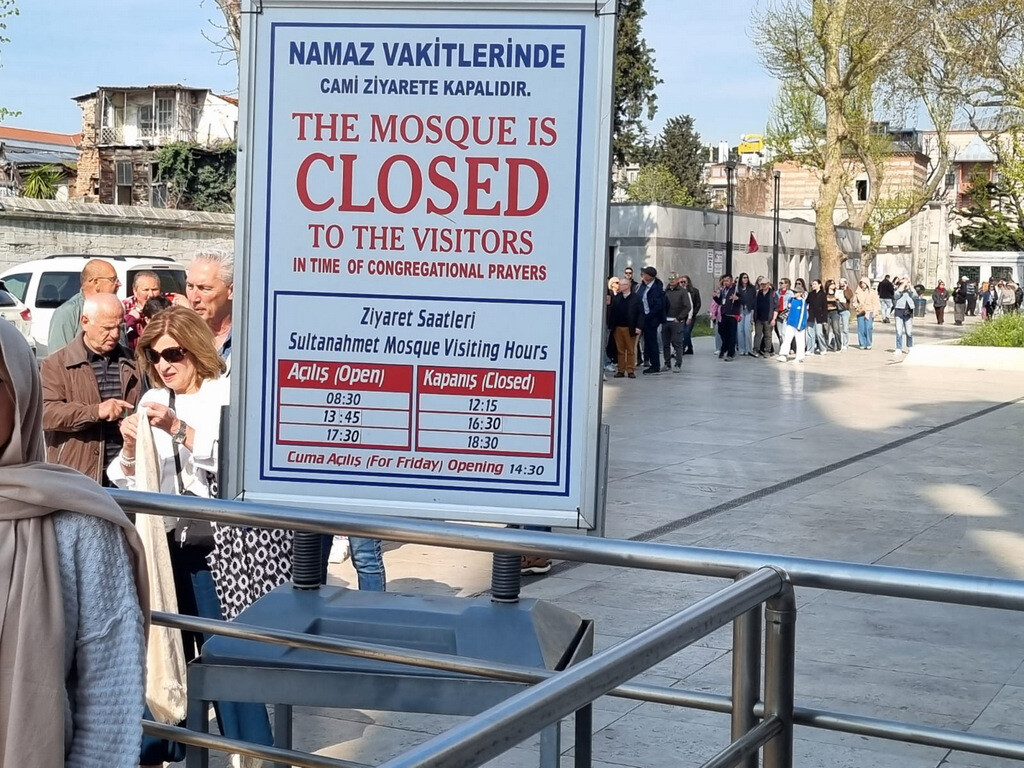
When planning your visit to the Blue Mosque, it is important to keep daily prayer times in mind. While general visiting hours are listed in this article, the most accurate and up-to-date information can always be found on the official website of Turkey’s Directorate of Religious Affairs, where daily prayer schedules are published.
A key detail many visitors overlook is that the mosque closes before the call to prayer (adhan). Large imperial mosques such as the Blue Mosque and the Suleymaniye Mosque are typically closed to tourists about one hour before each prayer, allowing time to prepare the space for worshippers.
For example, if the noon prayer (Dhuhr) is listed as 13:00, the mosque may close to visitors around 12:00 and reopen approximately 30 minutes after the prayer, often around 13:30. Keeping this buffer in mind will help you avoid arriving just before a temporary closure and make your visit smoother and more enjoyable.
Blue Mosque Entrance Fee & Dress Code (2026)
There is no entrance fee to visit the Blue Mosque. As with all mosques in Istanbul, entry is free of charge for both worshippers and tourists. You are welcome to explore the mosque without purchasing a ticket.
However, visitors are expected to follow a modest dress code. Women should bring a scarf to cover their hair. If you don’t have one, scarves and covering gowns are provided free of charge at the entrance.
Female visitors wearing short skirts or sleeveless tops will be asked to cover up with a gown. Men wearing shorts that do not cover the knees may also be asked to use a wraparound cloth.
Blue Mosque Entry & Tour Options (2026)
Enhance your visit to the Blue Mosque with a guided experience and choose between a standalone guided tour or a combined tour with Hagia Sophia.
Tours are guaranteed by GetYourGuide and can be canceled up to 24 hours in advance for a full refund.
Current Restoration Status of the Mosque (2026)
A long-term restoration project was carried out at the Blue Mosque between 2015 and 2023, and by 2026, the vast majority of this work has been completed. While minor restoration activities may still be visible in limited areas, they do not interfere with the visitor experience or restrict access to the main sections of the mosque.
During the restoration, some of the mosque’s most iconic features—including the main dome and the famous Iznik tiles lining the interior walls—were concealed behind protective coverings for several years. Today, these elements are once again fully visible, allowing visitors to appreciate the mosque’s interior as intended.
Another important improvement is the reopening of the outer courtyard, which had remained inaccessible for a long time. With this area now open, visitors can enjoy the full spatial layout of the mosque complex and better understand its monumental scale within Sultanahmet Square.
How to Get There?
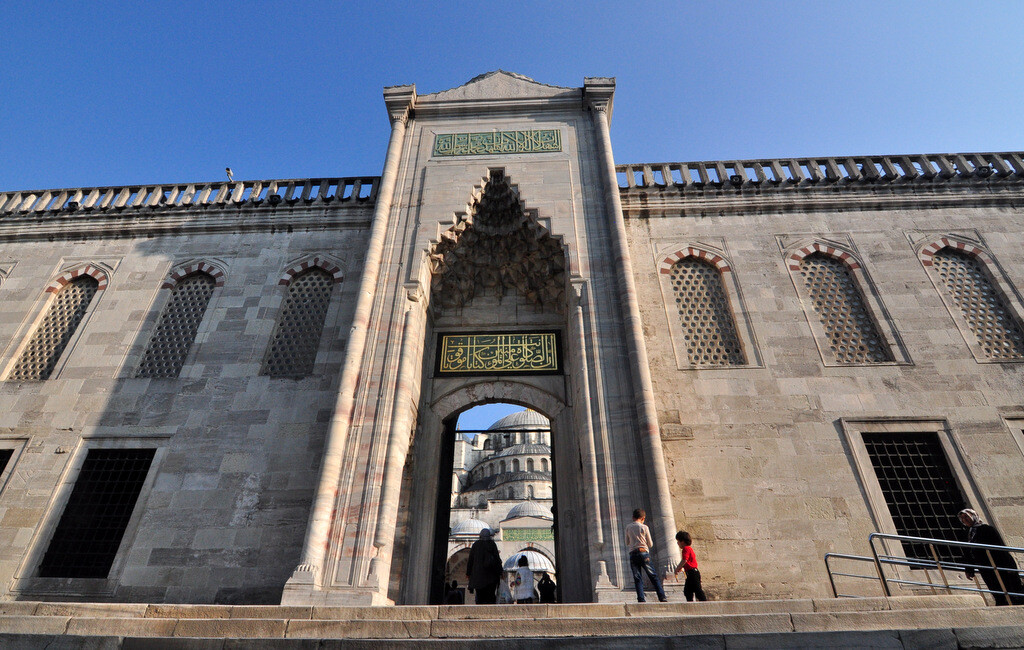
The Blue Mosque is located in Sultanahmet, the heart of Istanbul’s Historic Peninsula, and is easy to reach by public transport. The most convenient option is the Tram T1—get off at Sultanahmet stop, which is just a short walk from the mosque.
If you are staying around Taksim Square, take the funicular down to Kabataş and transfer to the Tram T1 toward Bağcılar. From Eminönü or Karaköy, you can also reach Sultanahmet directly by tram. Due to limited parking and frequent traffic, public transport is generally the fastest and most reliable way to visit the Blue Mosque.
Conclusion
The Blue Mosque remains one of the defining landmarks of Istanbul’s skyline, welcoming millions of visitors each year. Its harmonious proportions, refined interior decoration, and living spiritual atmosphere make it much more than a monument—it is still an active place of worship at the heart of the Old City.
While the mosque can certainly be admired on your own, understanding its historical context, architectural symbolism, and place within Ottoman Istanbul adds an entirely different layer to the experience. Even small details—such as its location opposite Hagia Sophia or its six minarets—carry meanings that are easy to miss without background knowledge.
That said, the Blue Mosque is only one chapter of Istanbul’s rich architectural story. From early Ottoman structures to classical masterpieces and later imperial mosques, the city offers a remarkable range of sacred architecture. If you’d like to continue exploring this legacy, you can find a curated overview in my Best Mosques in Istanbul article, where I highlight the most important examples across different periods of the city’s history.

Thanks for the information and amazing picture!
You are welcome! I am glad that you enjoyed it. Have a nice trip in Istanbul!
I fell upon your Istanbul Clues.
Thank you for this written “guided tour” starting with the Blue Mosque. Why it was located where it was.
I’m only a short time in Istanbul – this was so helpful, directing me for an enjoyable walk.
Hi Judith, thanks for the feedback about the blog. I’m glad the article was useful to you.
Juste un grand merci pour toutes ces informations et cartes. Je viens visiter votre ville avec mes deux adolescents dans quelques jours…
Encore merci.
Bien à vous,
Laurence
Bonjour Laurence, je ne parle pas réellement français et je dois utiliser Google Translate pour vous écrire une réponse appropriée. Merci pour vos gentils mots sur mon site. Bon voyage, Serhat.
Hi,
Myself (male) and 2 females are coming from 4-7 November, looking to possibly hire you for a day or 1/2 a day
Would love to discuss with yourself
Many thanks,
Tyler
Dear Tyler,
Yes, I have availability for those dates in November. I will contact you about the details of the tour from the e-mail address registered in the system.
Kind regards,
Serhat Engul
Serhat,
We will be visiting Istanbul June 8 and 9th, staying in the Sultanahmet area, and are interested in a 1/2 or whole day tour. We have 8 or 10 in our group and we’re wondering about your charges for that size group and also wondering if your guided tours would allow us to skip the lines at any museums that we visit with you? Topkapi or Dolmabahce are of special interest.
Thanks,
Rick
Hi Rick, thank you for the tour request. I also received these details by email. I will send options regarding this specific tour itinerary to your email.
Hello Serhat,
I am coming to Istanbul on April 20th and staying at the Pera Palace with a friend. Being two women, we would like a tour of Instanbul. We have both been to Istanbul before.
Want to see the Blue Mosque as it was closed when I was there in Jan. Also the cistern was closed. Can we hire you for 1/2 day or a day? How much do you charge?
Are these two sights now open?
Thank you.
Bonnie Pinkerton
Dear Bonnie Pinkerton, thank you for reaching out. Your email address is registered in the system. I will inform you via email. Best regards, Serhat Engul.