The mosaics of Hagia Sophia are not simply works of art. They are fragments of a civilization that once defined the world around the Mediterranean.
Created between the 9th and 13th centuries, these mosaics belong to a period when the Byzantine Empire was redefining itself after centuries of theological conflict. Some of the earlier images had already been destroyed during Iconoclasm. What we see today are not just decorations, but carefully chosen statements about faith, power, and legitimacy.
Hagia Sophia itself has lived many lives. Built in 537 as the greatest church of the Byzantine world, it remained so for nearly 900 years. After the Ottoman conquest in 1453, it was converted into a mosque and continued to function as such for almost five centuries. In the 1930s, it became a museum, revealing many of its hidden mosaics once again. And since 2020, it has returned to being a mosque.
Because of this layered history, the mosaics inside Hagia Sophia are not frozen in time. They are part of an ongoing story — one that continues to evolve even today.
Why Hagia Sophia’s Mosaics Still Matter
To understand these mosaics, you need to move beyond the idea of “religious decoration.”
In Byzantium, art was never neutral. Every image inside Hagia Sophia was part of a larger system that connected theology, imperial authority, and public space. The famous image of the Virgin in the apse, for example, was not just a devotional icon. It was a declaration: after the end of Iconoclasm in 843, sacred images had returned — and with them, the authority of Orthodox belief.
The same logic applies to the imperial mosaics. When emperors such as Constantine IX or John II are depicted offering gifts to Christ, they are not simply shown as pious rulers. They are placing themselves within a divine order, reinforcing their legitimacy through visual language.
This is what makes Hagia Sophia different from other famous mosaic sites like Basilica of San Vitale or the Chora Church. Here, the mosaics are not isolated masterpieces. They are part of a carefully designed program, displayed at the very heart of an empire.
And that location matters.
Hagia Sophia stood directly next to the Great Palace, connected through the Augustaion square. It was not just a place of worship, but a stage where the relationship between church and state was constantly performed. Every mosaic you see here was, in a sense, a public statement addressed to the entire Christian world.
Are Hagia Sophia’s Mosaics Still Visible Today?
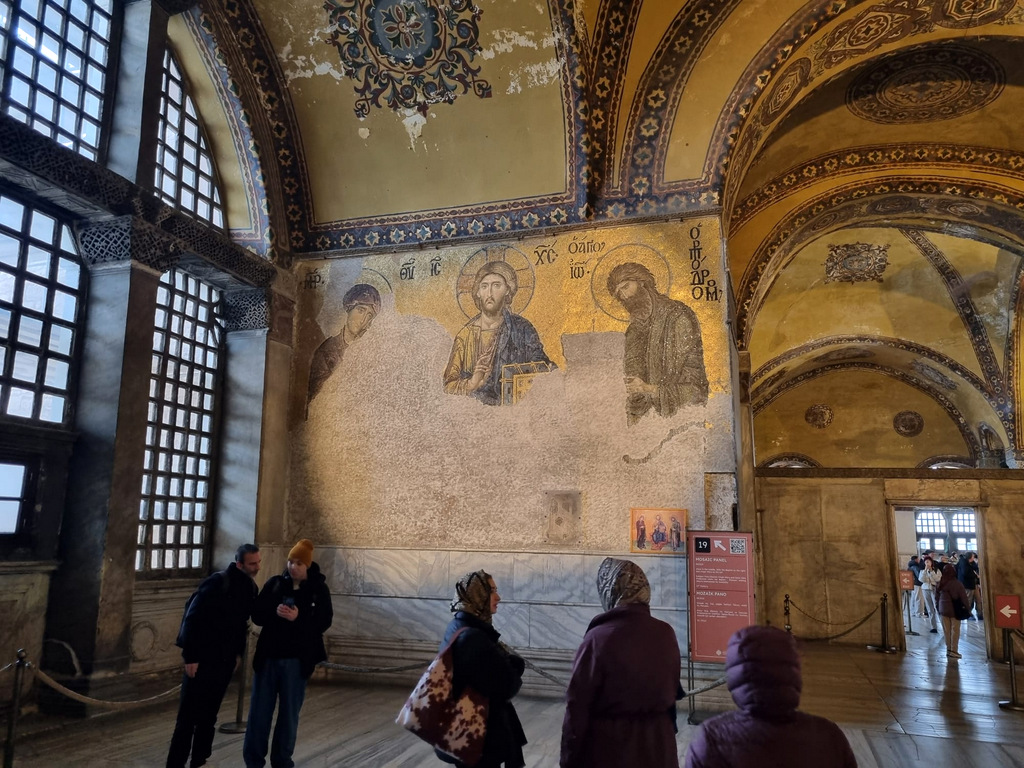
When Hagia Sophia was converted back into a mosque in 2020, there was considerable uncertainty about the fate of its mosaics.
However, as of April 2026, most of the famous Byzantine mosaics are still accessible to visitors.
Under the current visitor system, the building is divided into two distinct zones. The ground floor (nave) is reserved for worship, meaning tourists can no longer freely explore this area. In contrast, the upper galleries are open exclusively to visitors.
By purchasing a ticket (25 Euros as of 2026), you can access the upper floor, where the majority of the surviving mosaics are located.
Of the six major mosaics discussed in this guide, three are directly on the visitor route in the upper gallery: the Deesis, the Zoe mosaic, and the Komnenos mosaic. With careful attention and the right vantage points, you can also see two additional mosaics located on the ground floor.
One of them is the famous panel of Emperor Justinian and Emperor Constantine, which appears near the exit ramp. The other is the apse mosaic of the Virgin and Child, partially visible from the upper level depending on the light and the position of the curtains.
There is, however, one important exception.
The mosaic of Emperor Leo VI, located above the Imperial Gate on the ground floor, remains completely outside the current visitor route and cannot be seen.
Where to Find the Mosaics Inside Hagia Sophia
The mosaics of Hagia Sophia are not randomly placed. Their locations follow a clear hierarchy that reflects Byzantine religious and political thought.
The most sacred image — the Virgin and Child — is placed high in the apse, at the eastern end of the building. This is the spiritual focal point of the structure.
The imperial and dynastic mosaics, on the other hand, are located in the upper galleries, particularly in the south gallery. This area was closely associated with imperial ceremonies and provided a more controlled, elite viewing space. It is here that you will encounter the Deesis mosaic, as well as the portraits of Empress Zoe and the Komnenos family.
The entrance and transition spaces also carry meaning. Certain mosaics were positioned to mark thresholds — moments where visitors symbolically moved from the outside world into a sacred interior.
Understanding this spatial logic changes the way you experience Hagia Sophia.
You are not simply looking at isolated artworks. You are moving through a carefully constructed visual narrative, where each image occupies its place within a larger story.
The Silent Witnesses: Seraphim Angels
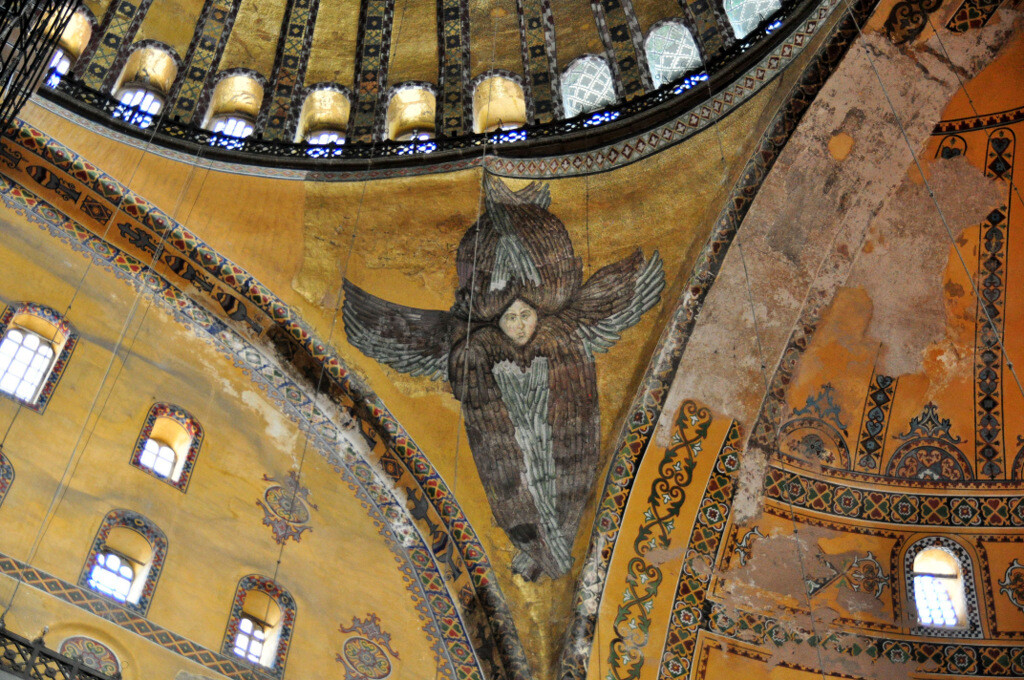
High above the vast interior of Hagia Sophia, where the weight of the dome seems almost impossible to comprehend, four silent figures watch over the space.
These are the Seraphim.
Positioned on the pendentives — the curved triangular structures that carry the dome — they occupy one of the most critical points in the building. Architecturally, they stand at the transition between earth and heaven. Symbolically, they belong entirely to the latter.
In Byzantine belief, Seraphim were not ordinary angels. They were the closest beings to the divine throne, described in early Christian texts as six-winged guardians of God’s presence. In Hagia Sophia, their role was clear: they were not simply decorating the dome, but protecting the sacred order it represented.
Over time, this idea evolved into something larger.
According to later traditions, these angels did not just guard the heavens — they guarded Constantinople itself. A city that endured countless sieges over nearly a thousand years was, in the imagination of its inhabitants, under divine protection. And these figures, suspended beneath the dome, became part of that belief.
To understand this, you need to remember what Hagia Sophia represented.
This was not an ordinary church. It stood at the heart of an empire that saw itself as the continuation of Rome — not only politically, but spiritually. The relationship between imperial authority and divine order was not abstract here. It was visible, staged, and reinforced through architecture and imagery.
The Seraphim were part of that system.
And yet, their story did not end with Byzantium.
After 1453, when Hagia Sophia was converted into a mosque, these figures were not destroyed. Instead, their faces were covered — in accordance with Islamic artistic traditions — while their wings remained visible. This decision is one of the most revealing details in the building’s long history.
It tells us that Hagia Sophia was not treated as a structure to be erased, but as one to be adapted.
Centuries later, during restoration works in 2009, one of these faces was uncovered again. For the first time in generations, a Seraphim looked back at the visitors beneath the dome.
Today, the others remain partially hidden.
And this, perhaps, is the most fitting state for them.
They are still there — not fully revealed, not completely concealed — continuing their silent watch over a building that has never belonged to a single moment in history.
The Stories Behind the Hagia Sophia Mosaics
The mosaics you see in Hagia Sophia today were not created when the building was first completed in 537.
In fact, almost everything visible on its walls belongs to a much later period.
To understand why, you need to step into one of the most turbulent chapters of Byzantine history: Iconoclasm.
Between 726 and 843, religious images across the empire were systematically destroyed. What began with Emperor Leo III removing an image of Christ from the Chalke Gate of the Great Palace quickly turned into a widespread movement against sacred imagery. Churches were stripped of their icons, and earlier mosaics disappeared.
When this period finally ended in the 9th century, the return of images was not gradual — it was deliberate.
The new mosaics created inside Hagia Sophia were part of a powerful visual statement. They did not simply decorate the building. They declared that images had returned, and with them, a restored religious and imperial order.
This is why most of the mosaics in Hagia Sophia belong to what we call Late Byzantine art, dating between the 9th and 13th centuries. The famous Virgin and Child in the apse, for example, stands not only as a religious icon, but as a symbol of this restoration.
Their story did not end there.
After 1453, when Hagia Sophia became a mosque, these mosaics were not immediately destroyed. Many remained visible for centuries before being gradually covered with a thin layer of plaster, especially from the 18th century onward. In the 20th century, they were uncovered again during extensive restoration works, revealing a visual history that had been hidden in plain sight.
What you see today is the result of all these layers.
These mosaics are not just remnants of the past. They are the visible traces of conflict, restoration, adaptation, and survival — all preserved within the same walls.
1. The Emperor Who Knelt: Leo VI Mosaic
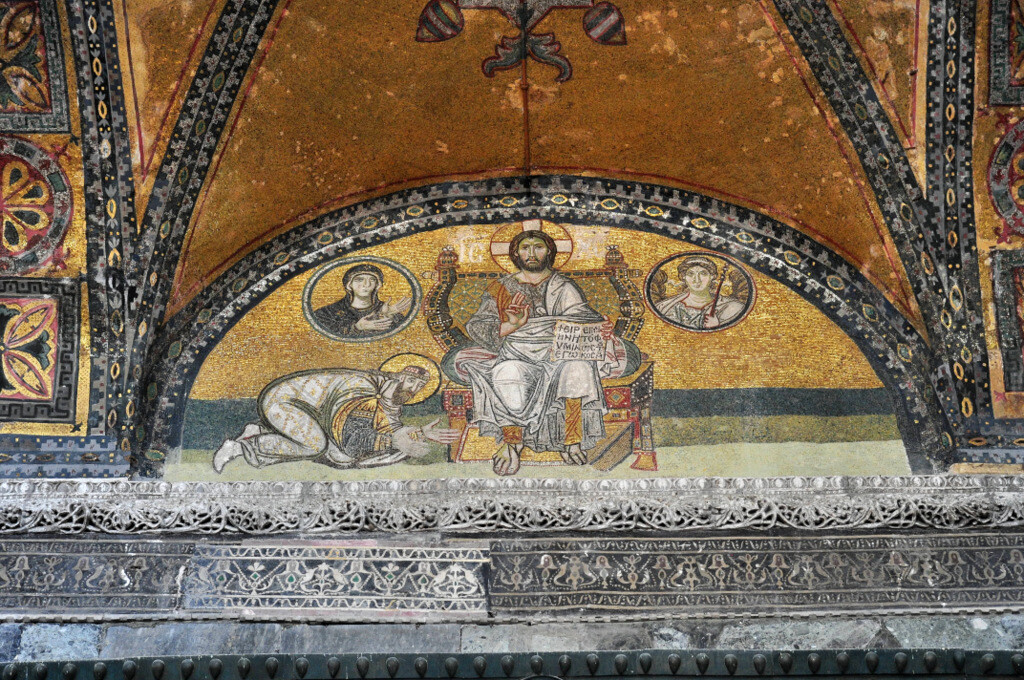
Just above the Imperial Gate of Hagia Sophia, there is an image most visitors never get to see.
It shows an emperor kneeling before Christ.
This is Leo VI, known as “the Wise,” who ruled the Byzantine Empire between 886 and 912. In the mosaic, Christ sits on a throne, raising his hand in blessing. In the medallions on either side, the Virgin Mary and the Archangel Gabriel witness the scene.
But what makes this image extraordinary is not its composition.
It is the story behind it.
Leo VI’s life was marked by a crisis that shook the foundations of Byzantine society — his marriages. According to the traditions of the Orthodox Church, a fourth marriage was strictly forbidden. Yet Leo pursued it anyway, driven by a single goal: securing an heir.
His first marriage, arranged by his predecessor Basil I, was to Theophano — a deeply religious woman later venerated as a saint. After her death in 897, Leo remarried, only to lose his second wife in 899 and his third in 901.
Still without a male heir, he entered into a fourth marriage.
This decision triggered a major conflict with the Church. The union was condemned, and for a time, Leo stood in direct opposition to the religious authority that legitimized imperial rule.
Eventually, a compromise was reached.
From this controversial union came Constantine VII, later known as Porphyrogenitus — “born in the purple.” His birth secured the continuity of the dynasty, but the shadow of the scandal remained.
And this is where the mosaic becomes something more than an image.
The emperor is not standing.
He is kneeling.
In a society where the emperor was seen as God’s representative on earth, this posture is striking. It reflects not power, but submission — a visual acknowledgment of the tension between imperial authority and divine law.
Even the location of the mosaic reinforces this meaning.
It is placed above the Imperial Gate, the entrance reserved exclusively for the emperor. Every time he passed beneath it, the message was clear: authority was not absolute.
Today, however, this powerful image remains out of reach.
Because it is located on the ground floor, within the active prayer area of Hagia Sophia, the mosaic is no longer visible to tourists. It exists just beyond the visitor route — present, but inaccessible.
And perhaps that, too, is fitting.
Some of the most revealing stories of Hagia Sophia are not the ones you see, but the ones that remain just out of sight.
2. The Throne of Heaven: Virgin and Child Mosaic
When you enter the vast interior of Hagia Sophia, your eyes are drawn upward almost instinctively.
First to the dome.
And then, almost immediately, to the apse.
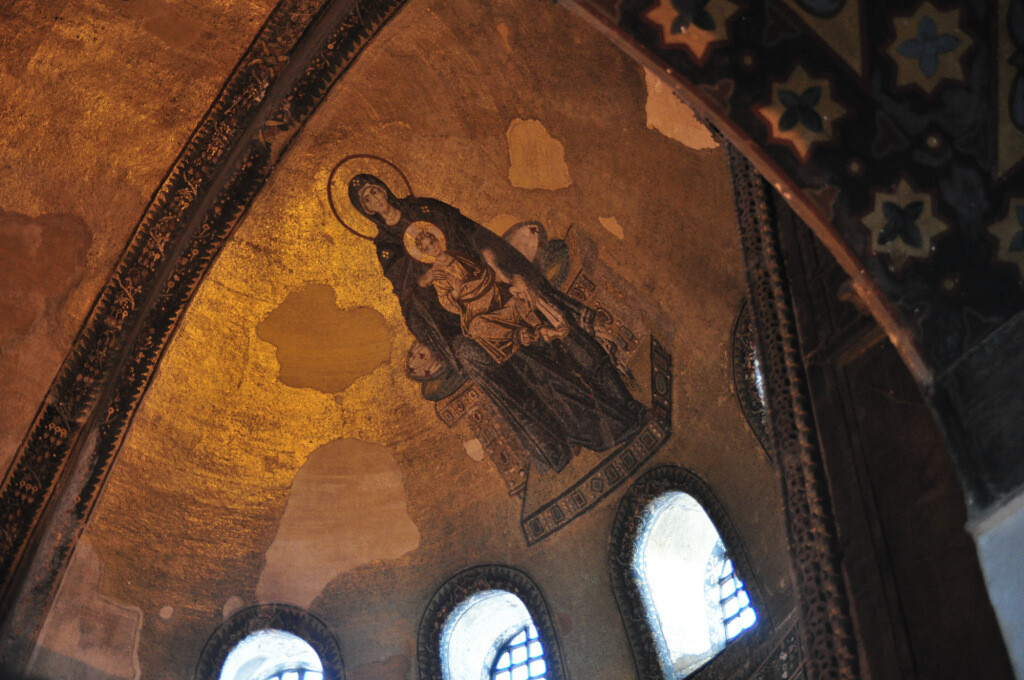
There, suspended in gold, sits the Virgin and Child.
This mosaic, created in the 9th century, is the oldest surviving image inside Hagia Sophia. But its importance is not defined by age alone. It marks a moment when the visual language of Byzantium returned after more than a century of silence.
For generations, the interior of Hagia Sophia had been stripped of its human figures. During the period of Iconoclasm, sacred images were removed or destroyed, replaced by abstract symbols and simple crosses. The space remained vast, but something essential was missing.
Then, in the 860s, this image appeared.
Mary is seated on a jeweled throne, dressed in deep blue. The child Christ rests on her lap, rendered in gold. The composition is monumental, deliberately scaled to be visible from every corner of the church.
But what matters is not only what is depicted.
It is what the image declares.
After decades of theological conflict, this mosaic announces the return of sacred imagery — not quietly, but with authority. It occupies the most important position in the building, the apse, where heaven and earth were believed to meet.
This is not simply a devotional image.
It is a statement.
A statement that images had returned. That the invisible could once again be made visible. And that the order disrupted by Iconoclasm had been restored.
Its placement reinforces this meaning.
Every visitor entering Hagia Sophia through the Imperial Gate would first encounter the vastness of the dome, and then, directly ahead, this image. The experience was carefully orchestrated. The architecture leads the eye, and the mosaic completes the message.
Even today, that effect remains.
Not because the image has stayed unchanged, but because it continues to exist within a layered and shifting space. Its visibility may vary, its context may evolve, but its presence endures.
And in Hagia Sophia, that is often what matters most.
3. Founders of a City: Justinian and Constantine Mosaic
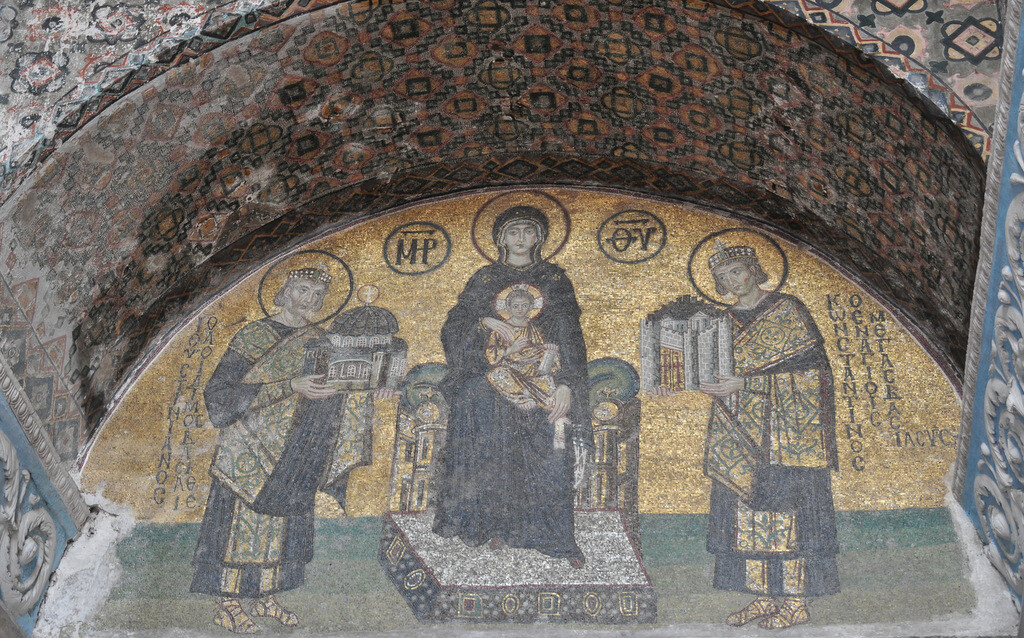
As you leave Hagia Sophia, there is one final image waiting — though most visitors walk past it without ever noticing.
It is not placed at the center of the building.
It does not dominate the space like the apse mosaic.
And yet, it may be one of the most revealing images inside Hagia Sophia.
It brings together two emperors who never lived at the same time.
Constantine and Justinian.
Created in the 10th century, this mosaic does not depict a historical moment. Instead, it constructs an idea — a carefully designed vision of continuity.
On one side stands Constantine I, the founder of the city. It was his decision to move the capital of the Roman Empire eastward and establish Constantinople that reshaped the course of history. In Byzantine memory, he was not just a ruler, but a figure of origin — almost a symbolic ancestor.
On the other side stands Justinian I, the emperor who brought that vision to its peak. In the 6th century, he sought to restore the Roman Empire to its former glory, extending its reach into Italy and commissioning some of its most ambitious architectural works.
Between them is the focus of the scene.
The Virgin and Child.
Each emperor presents his greatest achievement.
Constantine offers the city itself — Constantinople.
Justinian offers Hagia Sophia.
This is not a gesture of devotion alone.
It is a statement about legitimacy.
The city and the church, the political and the sacred, are presented together, as if they were inseparable. The message is clear: the empire exists within a divine order, and its greatest works are not possessions, but offerings.
Even the timing of the mosaic matters.
By the 10th century, both emperors had long been gone. Yet their presence here shows how strongly their legacy endured. This was how Byzantium understood itself — not as a fleeting power, but as a continuation of a sacred and imperial tradition.
And then there is its location.
Unlike the grand images in the upper galleries, this mosaic is positioned in a transitional space, near the exit. It does not announce itself. It waits.
To see it, you have to pause.
You have to turn back.
And in that moment, just before leaving Hagia Sophia, you encounter a final idea:
that this building was never just a monument —
it was the center of a world that believed its existence had meaning.
4. A Prayer for Mercy: The Deesis Mosaic
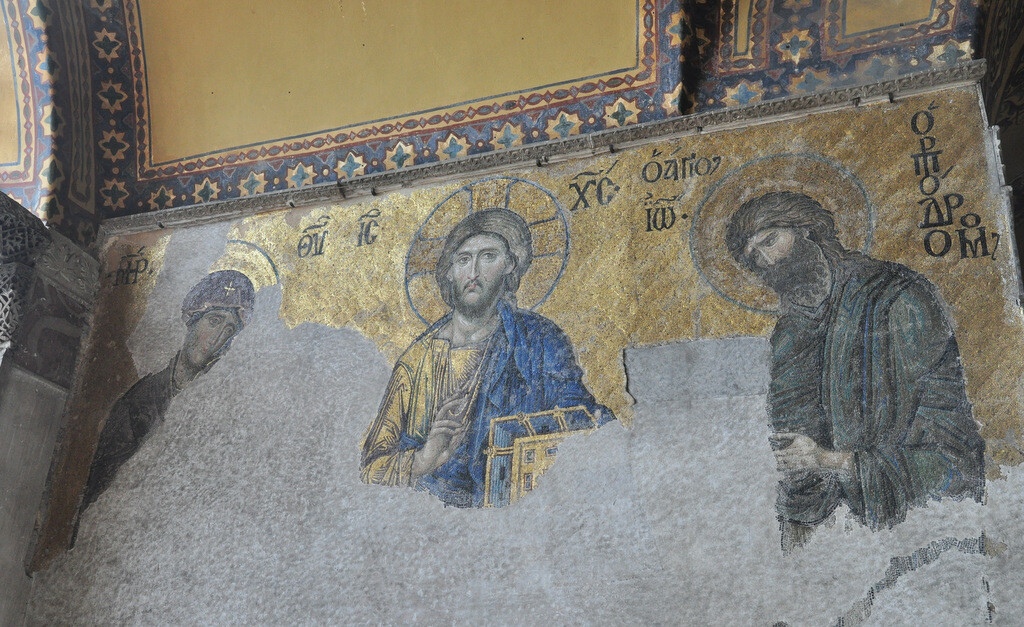
In the upper gallery of Hagia Sophia, there is a mosaic that feels different from all the others.
It does not assert power.
It does not celebrate authority.
It asks for mercy.
At the center stands Christ Pantocrator — the ruler of all.
On either side, the Virgin Mary and John the Baptist turn toward him, their bodies slightly inclined, their faces filled with quiet urgency.
They are not speaking.
They are pleading.
This is the Deesis.
Created in the 13th century, this mosaic belongs to a very different moment in Byzantine history. By the time it was made, the empire was no longer at its height. It had already experienced one of the most devastating events in its history — the sack of Constantinople during the Fourth Crusade in 1204.
For nearly sixty years, the city was no longer Byzantine.
When it was finally reclaimed in 1261, what returned was not the same empire. It was smaller, weaker, and marked by what it had endured.
And this is what you see here.
The Deesis is often described as the “Renaissance” of Byzantine art. Not because it returns to classical forms, but because something changes in the way human emotion is expressed.
Christ is no longer distant.
His face carries weight.
Mary and John are no longer symbolic figures placed beside him. They feel present, almost human, their expressions shaped by compassion and concern.
This is not a rigid theological image.
It is a moment.
A moment of intercession, where humanity stands between judgment and hope.
Even its current condition tells part of the story.
The lower portion of the mosaic has been lost over time, not through a single act of destruction, but through centuries of natural wear, structural movement, and exposure. What remains, however, is enough to convey its full impact.
And then there is the space around it.
The Deesis is located in the south gallery — an area once reserved for the imperial family. It was a place of privilege, of distance, of controlled perspective.
From here, the empire looked down upon the space below.
And yet, within this elevated position, the image does something unexpected.
It lowers the tone.
It replaces authority with humility.
And in doing so, it becomes one of the most powerful images in Hagia Sophia.
5. Power and Redemption: Empress Zoe Mosaic
Not all power in Byzantium was inherited.
Sometimes, it was negotiated.
Sometimes, it was contested.
And sometimes, it was rewritten — quite literally.
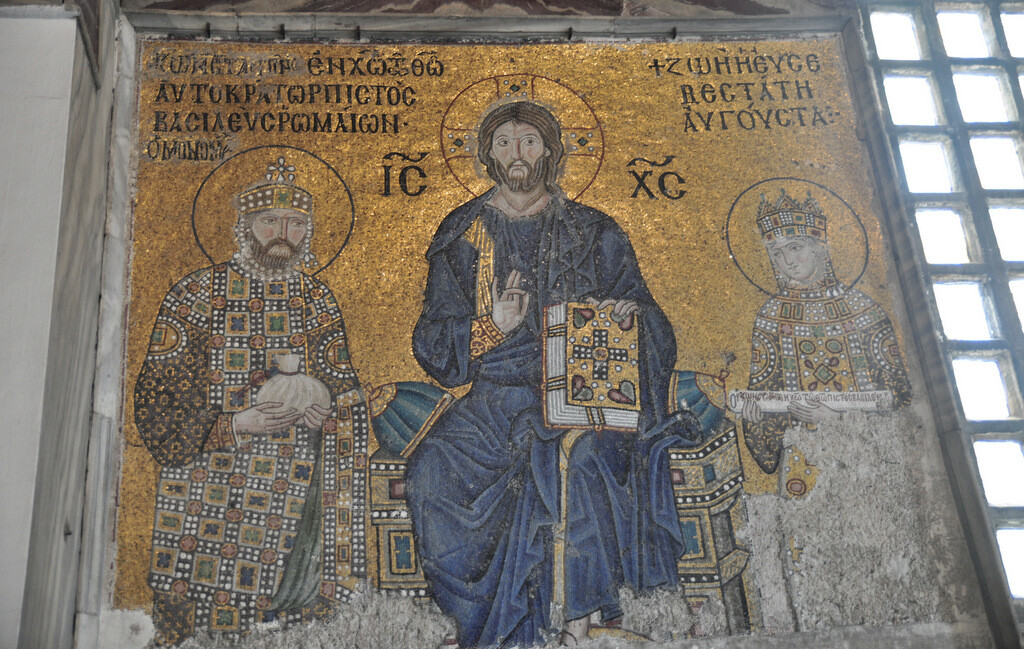
The mosaic of Empress Zoe, located in the south gallery of Hagia Sophia, is one of the most striking examples of this.
At first glance, the composition seems familiar. Christ sits at the center, holding a book and raising his hand in blessing. On either side stand the emperor and the empress, presenting their offerings.
But this is not a stable image.
It is a corrected one.
Zoe was the daughter of Emperor Constantine VIII and the last direct heir of the Macedonian dynasty. When her father died, the legitimacy of the throne rested entirely on her. Whoever she married would become emperor.
Her life unfolded accordingly.
She was first married to Romanos III, a man chosen by the court. After his sudden and suspicious death, she married Michael IV — a relationship shaped more by personal choice than political arrangement. When he died as well, Zoe entered into a third marriage with Constantine IX Monomachos.
And this is where the mosaic becomes something more than a portrait.
Historians agree that the mosaic was originally created for one of Zoe’s earlier marriages. Instead of producing a completely new image, the Byzantines chose a different solution.
They replaced the emperor.
The face you see today does not belong to the original figure. It was carefully removed and reworked to represent the new husband. Even the inscription above — the name Monomachos — had to be compressed to fit into a space not originally designed for it.
If you look closely, the evidence is still there.
The slight irregularities around the face, the adjustments in the tesserae, the tension in the composition — all reveal that this image has been altered.
This is not just art.
It is politics, preserved in glass and gold.
And yet, the message of the mosaic remains consistent.
Zoe and her husband are shown presenting their gifts to Christ, emphasizing their piety and their role as patrons of the Church. The visual language is clear: legitimacy flows through devotion.
But the reality behind it is more complex.
This is an image of power — but also of adaptation. A reminder that in Byzantium, authority was not always fixed. It could be reshaped, negotiated, and, when necessary, rewritten.
Even in stone.
6. A Fragile Dynasty: Komnenos Mosaic
Not all imperial portraits are about power.
Some are about memory.
In the south gallery of Hagia Sophia, just a few steps away from the Zoe mosaic, another image unfolds — quieter, more restrained, yet deeply human.
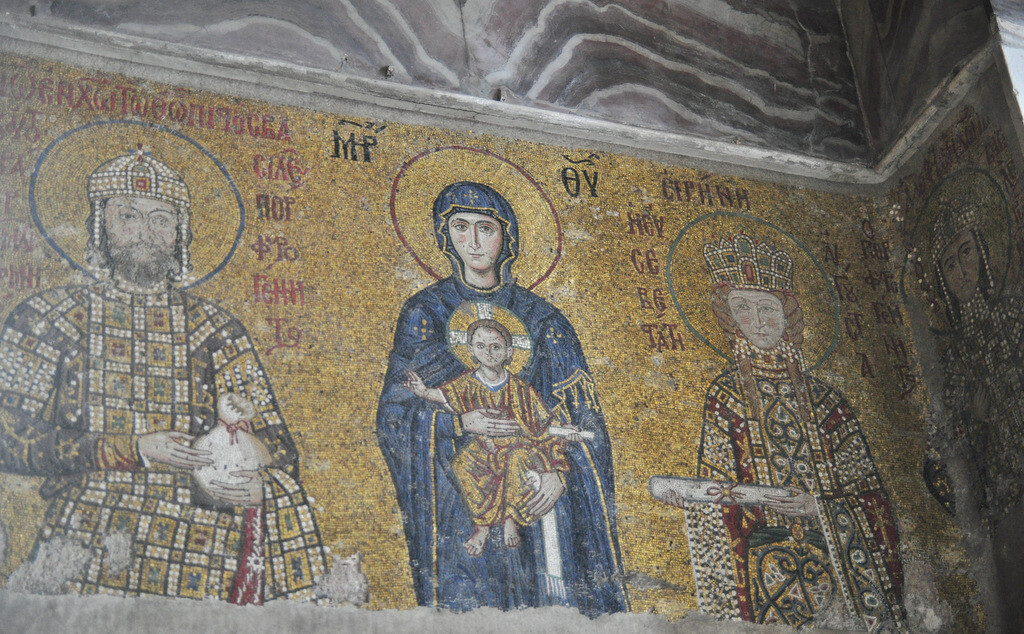
It shows Emperor John II Komnenos, his wife Empress Irene, and their son Alexios.
At the center, once again, is the Virgin and Child.
But the atmosphere here is different.
John II, known for his discipline and sense of duty, was one of the most respected rulers of his time. His reign in the 12th century marked a period of stability after years of political turbulence. Unlike many Byzantine emperors, he was remembered not for spectacle, but for consistency.
Beside him stands Irene.
Originally named Piroska, she was the daughter of the Hungarian king Ladislaus I. In the mosaic, her features stand out immediately. Her lighter complexion, her braided hair, and the subtle tones of her face reflect a level of realism rarely seen in earlier Byzantine works.
She does not look like an abstract ideal.
She looks like a person.
This is part of what makes this mosaic so distinctive. Compared to the more rigid and symbolic representations of earlier centuries, the figures here feel softer, more present — closer to lived experience.
And then there is Alexios.
Positioned at the edge of the composition, he does not carry the same sense of authority as his parents. His expression is noticeably different — more fragile, almost distant.
By the time this image was completed, Alexios had already fallen ill during a military campaign and died at a young age.
What you see here may not be a portrait of power, but of loss.
A dynasty at its height, yet already marked by absence.
Like many imperial mosaics in Hagia Sophia, this one also reflects the tradition of offering. The emperor and empress present their devotion through symbolic gifts, reinforcing their role as protectors of the faith.
But unlike the others, this image does not feel like a statement.
It feels like a moment held in place.
And perhaps that is why it stays with you.
For readers interested in a more immersive interpretation of this moment, you can explore The Mosaic of Time on Byzantine Stories, where the creation of this very mosaic is reimagined through a fictional narrative.
Understanding Hagia Sophia Through Its Mosaics
Hagia Sophia is often described as a monument.
But once you begin to follow its mosaics, it becomes something else.
It becomes a record of decisions, beliefs, conflicts, and compromises — all layered into a single space. Each image you encounter here was created in a specific moment, shaped by the needs of its time, and then carried forward into new contexts.
Some mosaics assert power.
Some seek legitimacy.
Some, like the Deesis, ask for mercy.
Together, they form a visual language that goes beyond decoration. They reveal how Byzantium understood itself — not only as an empire, but as a world where faith, authority, and identity were inseparable.
And Hagia Sophia was at the center of that world.
If you would like to explore this story further, you can continue with my detailed articles on Byzantine Constantinople and Byzantine Churches in Istanbul, where I examine how these ideas extended beyond Hagia Sophia into the wider city.
As a licensed tour guide specializing in Byzantine history in Istanbul, I also offer private walking tours that focus on the lesser-known layers of the city — from hidden churches to surviving fragments of the imperial past.
Because in Istanbul, the story of Byzantium is not confined to one building.
It is still present, waiting to be read.

Hello
Very interesting article. Most of these mosaics are now covered it seems …
I am amazed you fit so much in to a half day tour …. How can that be with the queues?
Yes, unfortunately some mosaics cannot be seen these days. I hope they open the upper floor soon so that all the mosaics can be seen.
I still do half day tours. However, I took Hagia Sophia out of my tours because of the long queues in front of it. My current half day tour includes Hippodrome, Blue Mosque, Basilica Cistern, Spice Bazaar and Rustem Pasha Mosque.
It’s possible to cover these sights in 3-4 hours.